
How Much Do CNC Turned Parts Cost in 2026? A Buyer's Cost Model
The price of a CNC turned part is a stack of claims. Material, machine time, tolerance, secondary work, and inspection each carry a number, and each number is only worth what the evidence behind it proves. A quote you cannot verify is a guess with a footer. This guide gives buyers a cost model for turned parts in 2026: the lines a real quote should name, the cost drivers that move each line, and the record that should arrive with the part. You will see why two shops can price the same drawing differently, and how to tell a defensible number from a hopeful one before you place the order.
What should a 2026 CNC turned parts budget actually contain?
Every turning quote, stripped of its formatting, is the same short list of lines. What separates one quote from another is whether each line names what it pays for, and whether the supplier can back the line with a record when you ask.
| Line | What it pays for | Evidence to ask for |
|---|---|---|
| Bar stock | The grade and diameter of the starting bar | Mill certificate; XRF check against it at receiving |
| Machining time | Spindle minutes on the turning machine | The machine family and the envelope it can hold |
| Tolerance and finish | The process steps needed to hold the print | CMM report; Cpk value on key characteristics |
| Setup and tooling | The fixed cost of proving the job once | Quantity tier; first-article coverage |
| Secondary work | Finishing, heat treatment, or plating steps | Whether the step runs in-house or at a named partner |
| Inspection and documentation | The reports that ship with the parts | Material cert, CMM report, and SPC chart in the box |
Read your quote against this list before you read the total. A quote that shows only a bottom line has not told you which rows it priced, and a budget built on an unnamed row is a budget that will move later.
How do machine choice and process steps set the price floor?
On turned parts, the machine is the first cost decision, because the machine decides how many operations the part needs. A simple bushing may run complete on one turning machine. A shaft with cross-holes and flats needs a mill-turn center so it is held once and machined without a second setup. A part with a ground seat moves into the grinding process family, which carries its own machine, its own queue, and its own inspection step.
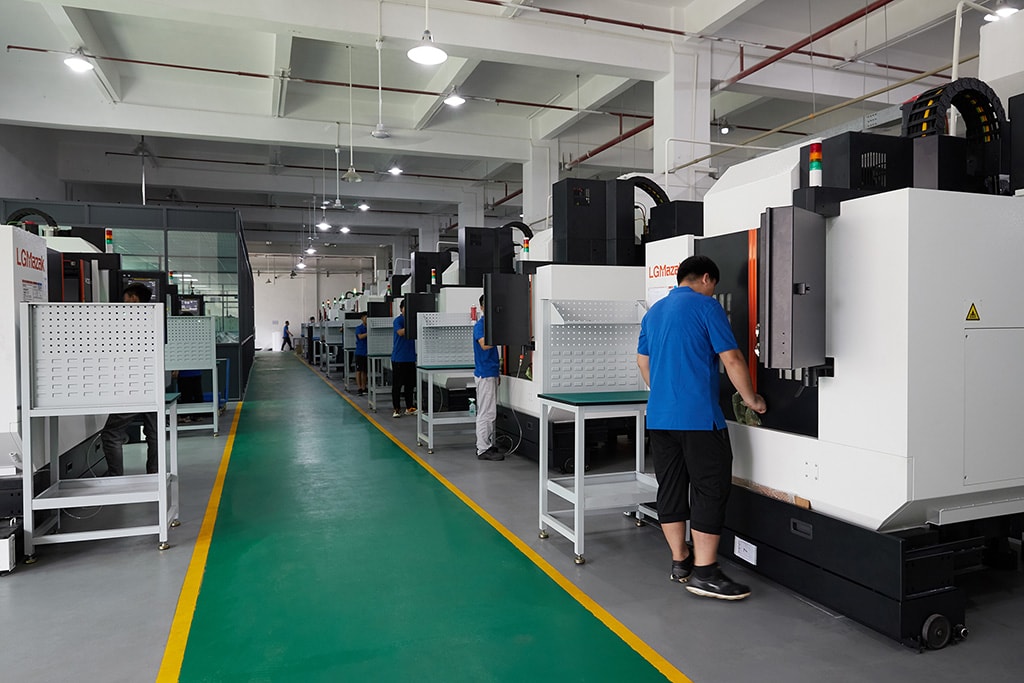
That is why the supplier's machine list matters as much as its price list. When turning, mill-turn, and grinding run in-house under one roof and one quality system, the route stays inside one accountable entity, and the quote reflects one process chain instead of a patchwork of handoffs. The floor behind this site runs 100+ production machines across 3, 4, and 5-axis milling, CNC turning, mill-turn, and precision grinding, inside a 6,800 m² facility. The capacity and certificate scope are verifiable facts, not marketing lines: the machines are the ones that will actually cut your part, and the scope covers the processes they run. You can read the same check in the services breakdown, where each process is tied to the certified system that runs it.
The envelope matters too. Turning here reaches Ø720 × 1280 mm and milling reaches 1300 × 700 × 600 mm. A part inside that envelope runs in one setup under the certified process; a part outside it needs a workaround. A shop that states its envelope at quoting time is saving you from discovering the limit after the order is placed.
How does bar stock move the price of a turned part?
Material moves a turning quote in two places: the bar itself, and the way it behaves at the cutting edge. Free-machining grades — 12L14 steel, 303 stainless, C360 brass — cut clean, break chips, and keep cycle times short. The demanding grades — 304 and 316 stainless that work-harden, titanium that runs slow — push spindle time up and wear tools faster. Aluminum 6061 sits at the economical end for lighter parts.
The material line is also where substitution risk hides. A supplier that prices 316 but loads 304 has changed the part before the first chip is cut. That risk is closed with a routine the buyer can name in the RFQ: every incoming lot is XRF-checked against its mill certificate at the door, before the bar reaches a machine. Ask for that check in writing. The mill certificate states what the lot claims to be; the XRF reading states what it actually is. When both are on file, the material line of the quote describes the metal in the machine, not the metal in the sales email.
Name the grade and the bar diameter on your drawing, not just the alloy family. A print that says "stainless" invites the cheapest interpretation; a print that says "316" with a bar size closes the gap before quoting starts.
How much do tolerance and surface finish move the price?
Tolerance is where turned-parts pricing gets steep, because it decides the process family and the inspection burden. On this floor, CNC turning holds ±0.003 mm on critical features and precision grinding reaches ±0.002 mm. The distance between those two numbers is not a small step — it is the difference between a lathe operation and a grinding operation, with a separate machine and a separate measurement step attached.
Process capability is the number that makes a tolerance claim credible. The quality system here targets Ppk ≥ 1.67 at the initial study on key characteristics and Cpk ≥ 1.33 on general characteristics. Capability is reported per characteristic: every report names the feature, its tolerance band, the sample size, the sigma method, and the study window., which means the process sits well inside the tolerance band with room for tool wear and temperature drift. A shop that quotes a tight tolerance without a Cpk value is quoting hope. A shop that can show the SPC chart is quoting a process it has already measured — the same evidence the quality page describes for audits and first articles.
Surface finish follows the same logic. A callout of Ra 0.8 µm on a sealing face is a different operation from Ra 3.2 µm on a clearance face, and the finish requirement has to be measured on a profilometer and documented. Put the Ra value on the drawing for the faces that matter, and the quote — and the inspection report — will both be honest about what you asked for.
How does quantity change the unit price on CNC turned parts?
The setup and programming on a turning job are fixed costs: they are the same whether you order one part or ten thousand. At one piece, that fixed cost lands entirely on that part, which is why a prototype looks expensive against a production run. As quantity rises, the setup spreads across the run and the unit price falls toward the sum of the bar and the cycle time.
The quantity curve has a second effect that belongs in the budget: it decides how much verification you can afford per part. A full CMM inspection on every piece of a high-volume run is rarely the right plan; the process is controlled with SPC on key characteristics and sampled inspection, and the reports ship with the batch. On a prototype, the inspection covers everything, because the point of the first article is to prove the process.
That is why the MOQ of 1 piece is worth more than it looks. Order one part first, confirm the part and its documentation against the print, and only then commit the volume. The single-piece order compresses the whole compliance question — material record, process, inspection, paperwork — into one shipment, at the cost of one part.
What do outsourced steps and secondary work add to the bill?
Turning rarely ends at the lathe. Cross-holes, keyways, and flats may need milling; threads may need a second operation; and finishing — anodizing, plating, coating, passivation — changes both the price and the compliance record. Heat treatment sits in the same category, because it changes what the part is, not just how it looks.
The honest question for the budget is whether each secondary step runs in-house or at a named partner. On this floor, surface finishing such as hard anodizing, zinc and nickel plating, powder coating, and mirror polishing runs partly through qualified partners. Heat treatment is split the same way: in-house ovens reach 500 °C, covering aluminum aging and low-temperature steel stress relief, while titanium stress relief above that range is outsourced and stated. A shop that names its partners is giving you the map you need to audit the whole route. A shop that hides the handoff is leaving a hole in your file that you will only find after a plating failure.
Budget each secondary step as its own line with its own lead time and its own documentation. A part that needs anodizing and a thread is three operations even if it started as one bar, and each added step is a place where cost, quality, and delivery can all move.
What hidden costs sit inside a cheap quote?
A low quote is not a saving until you know what it left out. The hidden costs on turned parts are rarely in the price at all — they appear later, as sorting, rework, replacement, or a compliance gap that a customer auditor finds for you.
- Unverified material. If the lot is not XRF-checked against a mill certificate, a substituted alloy is a discovery you will make in the field, not at the door.
- Unmeasured tolerance. A tight callout without a Cpk value is a promise the shop has not tested. The rework bills you later.
- Reconstructed documentation. Reports produced on request after delivery may describe a convenient story rather than the parts in the box. Documents that ship with the batch, tied to the lot number, are harder to fake.
- Unnamed scope. If the certificate scope does not cover a process you are buying, that process runs outside the audited system, and the compliance cost lands on you.
The supplier identity is the largest hidden line of all. Before the price means anything, check who signs the invoice. Dongguan Zhuohang Ltd is the legal entity behind this site — registered in 2005, checkable by its business registration 91441900MA4UWT6X39, and run from a 6,800 m² plant with 100+ people and 100+ machines. The certificates carry numbers a buyer can verify rather than logos a buyer can admire: ISO 9001:2015 (116024/A/0001/UK/En), IATF 16949:2016 (131941/A/0001/SM/En), and ISO 14001:2015 (116024/B/0001/UK/En). Note the IATF scope line too — it excludes product design under Clause 8.3, which makes this a build-to-print shop. A supplier that hands you a registrar number and a registry number in writing has priced its risk into the quote where you can audit it.
How do you compare two CNC turned parts quotes on the same basis?
A price is comparable only when the assumptions under it are stated. Different suppliers will quote the same drawing with different material grades, different process routes, and different inspection scopes, and each difference is a real cost gap, not a rounding error. Put every quote through the same checklist below before you weigh the totals.
- Material grade and verification. Same grade, same bar diameter, and the same XRF check against a mill certificate?
- Machine and route. Does the quote name the machine family and every process step, including grinding if the tolerance needs it?
- Tolerance with evidence. What Cpk does the shop hold on key characteristics, and can it show the SPC chart?
- Secondary work and partners. Which steps are in-house, which are outsourced, and is the partner named?
- Documentation with delivery. Does the material cert, CMM report, and SPC chart ship with the parts, tied to the lot?
- Certificate scope. Does the scope line cover every process you are buying, and is the certificate number checkable?
Apply the same list at the same quantity tier, because a drawing at fifty pieces and at five thousand is a different cost problem. Then weigh the price with the evidence in the same hand. The lowest number on the page is the cheapest only if the part arrives on grade, in tolerance, with the record that proves both.
How do you turn this model into a 2026 budget that holds?
A budget that holds starts before the quote does. Lock the drawing first: the grade, the bar diameter, the Ra values, the tolerance per critical feature, and the revision number. Then name the verification you expect — XRF at receiving, Cpk on key characteristics, reports that ship with the batch. Send that package to the shop, and you are asking for a price on a defined part with defined evidence, not a number on a guess.
When the quotes come back, read them against the checklist above, and treat documentation as part of the product rather than an extra. The real cost of a turned part in 2026 is not the line that looks cheapest; it is the line whose material, process, and records you can verify. That is the difference between a price you pay once and a price you pay again when the part fails, the audit arrives, or the customer asks where the alloy came from.
Frequently Asked Questions
How much do CNC turned parts cost in 2026?
No honest shop quotes a turned part without a drawing, because the price is set by the material grade, the process route, the tolerance band, and the quantity together. The budget lines are the same for every quote — bar stock, machine time, tolerance, setup, secondary work, and inspection — and the total depends on how demanding each line is on your part.
Why is a tiny turned part sometimes pricier than a bulky one?
A single diameter part that turns complete in one operation carries one machine-hour no matter how much metal it weighs. A small component that needs cross-holes, a thread, and a ground seat stacks several operations onto a short bar, and each added operation is a separate line on the quote. Watch the operation count, not the overall size, when you compare prices.
What tolerance band should a turned-parts budget plan for?
CNC turning on this floor holds ±0.003 mm on critical features, and the grinding process family reaches ±0.002 mm for the tightest seats and sealing surfaces. The budget rule is to match the band to the function: keep loose callouts loose, and spend the tolerance money only on the diameters that genuinely need it.
How do I know the material in the quote is the material in the part?
Ask for the verification in writing: every incoming lot is XRF-checked against its mill certificate before it reaches a machine. The certificate says what the lot claims to be; the XRF reading says what it is. A shop that can produce both for a past order is running the check.
What is the minimum order quantity for CNC turned parts?
One piece. The MOQ of 1 lets you order a first article, confirm the part and its documentation against the print, and then scale into production on the same drawing and the same process.
What documentation should ship with a turned parts order?
Material certificates with XRF verification, CMM inspection reports, and SPC charts should arrive with the parts, tied to the lot number on the packing slip. For automotive work, APQP/PPAP evidence — process flow, control plan, PFMEA — should also be available on request.
Is this a build-to-print supplier?
Yes. The IATF 16949:2016 certificate (131941/A/0001/SM/En) covers the manufacture of CNC metal machining parts and excludes product design under Clause 8.3. Design responsibility stays on your side, and manufacturing process control stays on the supplier's side.
Need a verifiable price on your CNC turned parts?
Send your drawing to [email protected] or call +86 13126536955 — the quote comes back with the material check, the process route, and the documentation plan named line by line.